
Every so often I’m asked what notebooks I like the best. Hands down, my answer is the Stillman & Birn Epsilon Series. I’ll explain why, because once you know what I’m looking for you’ll be able to judge any notebook for yourself.
The paper is wonderful
When we talk about brush drawing in a nature notebook, what we are doing is what’s now called wet-on-dry: a controlled brushful of color laid onto dry paper, not great floods of water. Generally, we are not painting sweeping landscapes. Instead, we are painting a single small flower that fits on the page, with more or less detail depending on the age and the ability of the child.
That practice means the paper must have two important qualities.
First, weight. At 150 gsm the Epsilon paper is heavy enough to take a little water without buckling and warping. Thin notebook paper cockles (that’s the official term papermakers use) the moment a wet brush touches it, and there is nothing more discouraging than watching your carefully painted flower pucker and wave as the paint collects where it shouldn’t. The heavier sheet holds its shape and holds up to erasing and layering too.
Second, is the smooth surface. There is a companion in the same line — the Alpha — that is identical in every way except that it has a medium grain, and therefore a bit of tooth to it. An artist friend of mine prefers that one. But while a toothy surface is lovely for loose washes and for pencil, where the grain grabs the pigment, a smooth surface is better for fine detail and handwriting. And that is exactly what our children are doing in their notebooks. They are painting small, detailed studies, of a single bloom or twig, for example, and they are also writing the details of their walks or the things they observed in nature. Because the same sheet has to serve both the writing and the painting, a smooth surface works best.
About the size
Charlotte Mason’s own notebooks measured about 7 x 9 inches — a generous, roomy page. The Epsilon doesn’t come in that exact size, but it comes in two sizes on either side of it.
The larger option is an 8 x 10 softcover. It’s the closest in spirit to Miss Mason’s generous proportions, with plenty of room for a child to write her narration on one side and paint on the other without feeling cramped. Because we don’t carry these notebooks out into the field, but instead bring specimens home to paint, the softcover is perfectly acceptable.
The smaller option is a 5.5 x 8.5 hardcover. It’s a bit more compact, and the firm cover is durable and keeps beautifully on a shelf as the years of study add up. The page is a little tighter but for anyone intimidated by the blank page, it’s a nice start.
Either one will serve you well. The paper inside is the same, and that is what matters most.
A few helpful extras
Over the years I’ve added a few small helps to my own notebook.
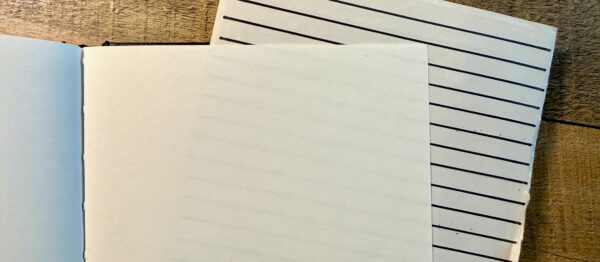
A lined guide to keep in the book. A blank page is best for the notebook since we don’t have a good option that is lined on one side and blank on the other like Charlotte Mason’s students had. However, a blank page can cause our handwriting to wander across the page. So I take a piece of lined binder paper and, with a permanent marker and a ruler, I trace over the lines to make them dark and bold. Then I cut the sheet down to the exact size of my notebook and tuck it behind whatever page I’m writing on. The dark lines show through just enough to keep my writing straight, and because I cut it to fit, it stays inside the book and is always there when I need it.
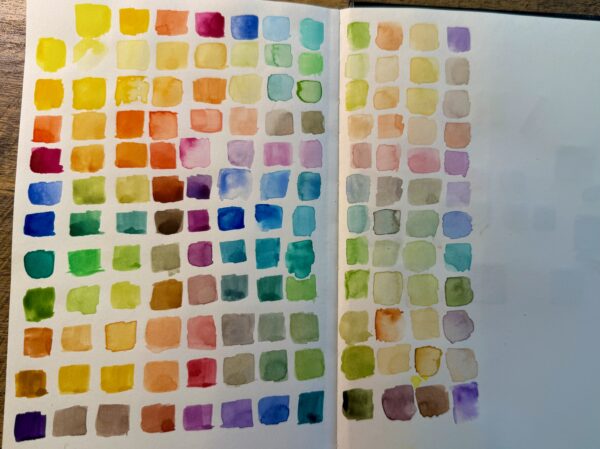
A color chart in the back. I’m not an artist and mixing a color to match my specimen is not always so easy. Therefore, on one of the last pages of my notebook, I lay out all my colors in a row across the top, in order. Then I add the same colors, in the same order, down the side. Where each row meets each column, I mix those two colors together. The same two colors will be included twice, so on the left of the chart I mix with less water, and on the right I mix with more. What I end up with is a full grid of every combination I can make, from deep to pale. And when I’m searching for just the right green for a particular leaf, I don’t guess and test. I just glance at my chart.
Science Notebooks
I used to recommend any old 8 x 10 sketchbook for science, but I’ve come to think the 8 x 10 softcover Epsilon (or the 8 x 10 hardcover) is a better choice here too — and for the same reasons.
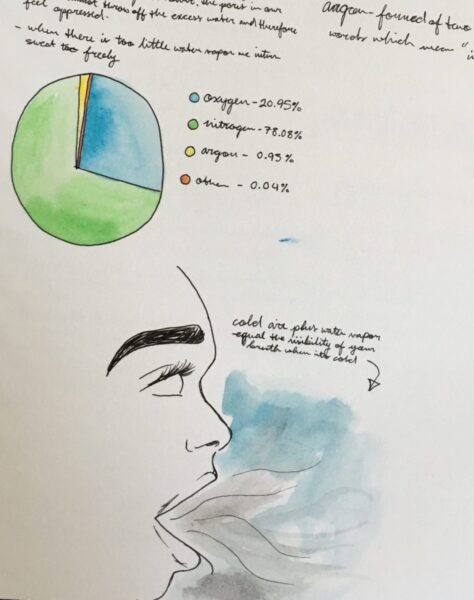
Beginning in Form 3, a student keeps a science notebook as the record of her own observation: a drawing of an experiment or a dissection, a reproduction of a drawing from the book, the occasional chart, and a written narration of what she has read and seen. So we have the same two demands as the nature notebook — careful drawing and handwriting.
The smooth surface is great here, because a science diagram depends on its labels and clean lines. And if a student adds color to a diagram, the 150 gsm weight will be a benefit too. There’s also a convenience in a child using the same familiar style of book for both her nature and science work.
Of course, while a nature notebook is necessary from the beginning and a science notebook is necessary starting in Form 3, these particular notebooks aren’t the only option. Still, I hope that hearing the reasons I love the Stillman & Birn Epsilon Series will help you pick a notebook for you and your kids that will suit you well.