Form 1 Science Curriculum (gr. 1-3)
In Form 1, your child’s science is entirely nature study and nature lore. Formal science (chemistry, physics, geology as school subjects) begins in Form 2, but the years before it do important foundational work of their own.
Charlotte Mason said it plainly: “out-of-door nature-study lays the foundation for science” (3/281). Everything your child will do later — observing carefully, describing accurately, reasoning from what they’ve seen — is being built now.
The work of Form 1 is to give your child regular contact with the natural world, and give them books that teach them what to look for when they get there. To understand the purpose of those books and how the lessons work, read Nature Lore: The Beginning of a Science Education.
The Weekly Schedule
Form 1 students have three ten-minute science lessons each week.
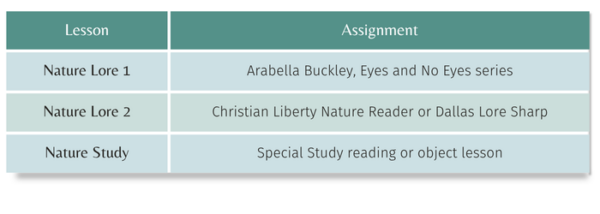
Each lesson is short: read for four or five minutes, then ask for an oral narration. Science narrations at this age are often brief and may sound like a simple list of what your child remembers. That is completely normal.
Nature Lore I: Arabella Buckley
Charlotte Mason assigned work from one of Arabella Buckley’s Eyes and No Eyes books every term. There are many excellent nature books available today, but I have not found anything to replace Miss Buckley’s series. In each book she approaches a category of plants or animals with a scientific eye that is exactly right for these young students.
These books can be taken in any order.
| Term | Assignment |
|---|---|
| 1 | Plant Life in Field & Garden by Arabella Buckley — omit chs. 8, 10-13 (LBP, YC) |
| 2 | Wild Life in Woods & Fields by Arabella Buckley — omit chs. 3 & 6 (LBP, YC) |
| 3 | By Pond & River by Arabella Buckley (LBP, YC) |
| 4 | Birds of the Air by Arabella Buckley — chs. 1-7 (LBP, YC) |
| 5 | Birds of the Air by Arabella Buckley — chs. 8-15 |
| 6 | Trees and Shrubs by Arabella Buckley — chs. 1-6 (LBP, YC) |
| 7 | Trees and Shrubs by Arabella Buckley — chs. 7-13 |
| 8 | Insect Life by Arabella Buckley — chs. 1-6 (LBP, YC) |
| 9 | Insect Life by Arabella Buckley — chs. 7-12 |
Nature Lore 2: A Second Book Each Week
A second nature lore book is read each week. Studying nature season by season was very important to Charlotte Mason, and these two titles go a long way toward opening a child’s eyes to what is happening outside right now.
| Term | Assignment |
|---|---|
| 1 | Christian Liberty Nature Reader Book I — first third (CLP) |
| 2 | Christian Liberty Nature Reader Book I — second third |
| 3 | Christian Liberty Nature Reader Book I — last third |
| 4 | The Fall of the Year by Dallas Lore Sharp — chs. 1-3, 5 & 1st half of chs. 4, 7, 12 (LBP, YC) |
| 5 | Winter by Dallas Lore Sharp — chs. 1-3 & 1st half of chs. 4, 7, 12 (LBP, YC) |
| 6 | The Spring of the Year by Dallas Lore Sharp — chs. 1-3, 5, 7 & 1st half of chs. 4, 6, 10 (LBP, YC) |
| 7 | The Fall of the Year by Dallas Lore Sharp — chs. 6, 8-11, 13-14 & 2nd half of chs. 4, 7, 12 |
| 8 | Winter by Dallas Lore Sharp — chs. 5-6, 8-11 & 2nd half of chs. 4, 7, 12 |
| 9 | The Spring of the Year by Dallas Lore Sharp — chs. 8-9, 11-13 & 2nd half of chs. 4, 7, 10 |
When using Dallas Lore Sharp, the teacher should read the corresponding “Notes and Suggestions to the Teacher” in the appendix.
Summer by Dallas Lore Sharp (LBP, YC) is also available if you school year-round or live in a warmer climate.
Nature Study: The Third Lesson
Each term, students make a special study of two or three season-specific objects, including both plants and animals. The third lesson is where some of that work happens, such as the special study reading.
Nature Explorers is my open-and-go nature study curriculum, written to help with this lesson. It guides you through a full year of special studies with object lesson videos, nature walk prompts, observation booklets, living book suggestions, and nature notebook ideas.
Other Notes
Don’t combine Form 1 students with older forms for science. Students within Form 1 may work together, but the work required in later forms is quite different. See Combining Students for Science Class.
- Miss Buckley’s books can feel more demanding than the storybook-style nature books your child is used to. Keep the reading short and be satisfied with a simple narration; your children will settle into the rhythm.
- Learn more in How To Do Nature Study.
- Sample Nature Notebooks.