
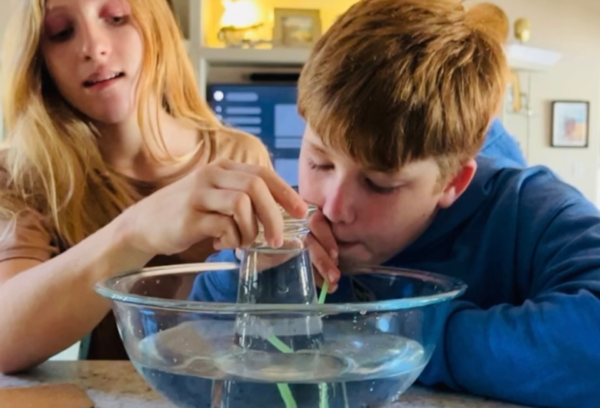
Combining students where possible can make all the difference when homeschooling with a Charlotte Mason method—especially if you have several children! Even Charlotte Mason herself wrote notes at the end of her programmes to guide parents in combining their students. That said, combining only works well when students are at the right level, so it’s worth understanding which groupings make sense and which don’t.
The General Rule: Combine Within a Form Level
The best and simplest guidance is this: combine all students who are within the same form level. All your Form 1 students can work together, all your Form 2 students can work together, all your Form 3 students can work together, and all your high school students can work together. Within a given form, the time allotments and expectations are the same, so combining is easy and natural.
Forms 1 (gr. 1–3) and 2 (gr. 4–6): Keep Each at Their Own Level
Forms 1 and 2 each need to stay at their own level and should not be combined with each other or with older students. The differences between these levels are significant enough that combining them would shortchange someone. A Form 1 student spends about ten minutes three times a week on nature lore readings; a Form 2 student spends twenty minutes on nature lore, twenty minutes on a formal science book, and thirty minutes on an experiment or special study—also three times a week. Moving a Form 1 student up to that pace, or pulling a Form 2 student back to nature lore only, would be unfair to both.
There’s also a practical reason to keep Form 1 and Form 2 students in their own work: if a younger child finishes the Form 1 books early, you’ll find yourself scrambling to locate Form 2 materials before they’ve actually reached that stage. Better to let each form do its own work at its own time.
Form 3 (gr. 7–8): Ideally Its Own Level, But Flexible When Needed
Form 3 is where things open up a little more. Ideally, your Form 3 students work at their own level, just as Forms 1 and 2 do. However, Form 3 students can be combined with high school students when circumstances call for it.
There are three situations where combining Form 3 and high school students makes particular sense:
First, when a family is new to a Charlotte Mason approach to science and has both a middle school and a high school student starting at the same time. In that case, it often makes sense to begin both students together using the Form 3 guides, giving the high schooler a strong foundation before moving into the high school level.
Second, when a student faces a learning challenge. Being combined with an older student can provide support and encouragement, and allows both students to work without requiring you to run two completely separate science programs.
Third, sometimes logistics simply make it necessary, and that’s all right too.
One thing that makes combining Form 3 and high school students particularly workable is that starting in Form 3, my guides are written directly to the student. This means your older students should be able to work largely on their own—reading, narrating, and completing experiments independently—while you give your attention to a younger child. You’ll still need to provide materials for experiments and hold students accountable for completing their work, but the moment-to-moment facilitation should not fall entirely on you.
Forms 3 and High School: How Combining Works in Practice
When you do combine Form 3 and high school students, they can read aloud to each other, discuss what they’re learning, and conduct experiments together—all largely without you, unless you need to gather supplies or step in for a discussion.
One important note for high school students: they must complete three guides in a single subject area to earn a transcript credit, but one or more of those guides can be at the Form 3–4 level. For example, a chemistry credit might look like this:
- Form 3-4 Chemistry
- HS Chemistry—part 1
- HS Chemistry—part 2
Or a student could earn an Earth Science credit by completing:
- Form 3-4 Earth Science, Geology
- Form 3-4 Earth Science, Weather
- Form 3-4 Earth Science, Astronomy
Sample Combined Schedule for Students Starting in Grades 7 and 9
7th grade & 9th grade
All year: Form 3-4 Biology
Term 1: Form 3-4 Chemistry
Term 2: Form 3-4 Physics
Term 3: Form 3-4 Earth Science, Geology
8th grade & 10th grade
All year: Form 3-4 Botany (can switch with Form 3-4 Biology if you want)
Term 1: HS Chemistry—part 1
Term 2: HS Physics—part 1
Term 3: Form 3-4 Earth Science—Weather
9th grade & 11th grade
All year: HS Biology—Anatomy, part 1 (or any of the HS biology courses)
Term 1: HS Chemistry—part 2
Term 2: HS Physics—part 2
Term 3: Form 3-4 Earth Science—Astronomy (prereq. for HS Physics, part 3, astrophysics)
10th grade & 12th grade
All year: HS Biology—Anatomy, part 2
Term 1: HS Chemistry—part 3
Term 2: HS Physics—part 3, Astrophysics or Theoretical Physics
Term 3: HS Earth Science—Geology
11th grade
All year: HS Biology—Ecology
Term 1: HS Biology—Microbiology, Biochemistry, or Forensics (or read a science book of interest)
Term 2: Form 3-4 Technology
Term 3: HS Earth Science—Weather
12th grade Do whatever hasn’t been done or follow the student’s interest.
All year: HS Biology—Origins
Term 1: HS Biology—Microbiology, Biochemistry, or Forensics (or read a science book of interest, such as The Immortal Life of Henrietta Lacks)
Term 2: HS Physics—Theoretical Physics or Astrophysics
Term 3: Student Choice
I hope that helps clarify things. Remember, this schedule is just a suggestion—a starting point for thinking through how your family’s years might unfold. You can adapt it as much as you need to.